Father-daughter team hikes famous footpath from Georgia to Maine
By Aislinn Sarnacki ’10
Mark Bolduc ’84 and his daughter Natalie Bolduc Nicols ’17, ’22G have gone on many outdoor adventures together, but in the spring of 2025, they embarked on their longest and most challenging journey to date: a thru-hike of the famous Appalachian Trail.
A continuous footpath that measures about 2,200 miles long, the AT offers an arduous journey as it follows the Appalachian Mountain Range from Springer Mountain in Georgia to Katahdin in Maine. On average, the trek takes five to seven months to complete — for those who get that far.
“With thru-hiking together, if you’re not compatible, it’s not going to work,” Mark Bolduc said. “If you aren’t the same speed, same attitude, same goals … So to be able to do it with my daughter is just tremendous, just a once-in-a-lifetime opportunity.”
Of the hundreds of hikers who set out to hike the entire trail each spring, only about a quarter of them make it to the end. Illness and injury cause many to stop early, while other challenges such as lack of funding and plummeting morale take others off the trail.
“It’s a really big commitment,” Natalie Nicols said. “But sometimes in life you just have to commit to things and not look back.”
The two had toyed with the idea of hiking the AT for years. In the winter of 2024, the stars aligned. Nicols, who earned her degree in nursing, was between jobs in healthcare, and Bolduc, president of The Fitch Company engineering firm, could plan ahead to take time off of work. Perhaps most importantly, both were in good physical health for the long-distance trek.
“I was totally on board with it,” said Kim Archambault Bolduc ’84, wife of Mark Bolduc and mother of Natalie Nicols. “It’s something they’d been talking about for years. They’re both very determined, and they love the outdoors.”
“Life goes by,” Nicols said. “You can always talk about things, but sometimes you have to just send it.”
Going the distance
Mark and Kim Bolduc of Dixfield met at UMaine in 1983, and both graduated the following year. All three of their children are also UMaine graduates.
The family has always done outdoor activities together like camping, skiing, and hiking, but when it comes to endurance outdoor sports, Mark Bolduc and Natalie Nicols take things to the next level. Together, they ran the 2014 Sugarloaf Marathon and did so well that they qualified for the prestigious Boston Marathon, which they ran in 2015.
In more recent years, they both raced in the 2023 Big Brad 50K Ultra Trail Race at Bradbury Mountain State Park in Pownal. They also completed the 2024 Northwoods Gravel Grind, a 70-mile bike race on logging roads northwest of Rangeley. And they participated in the 2024 Uphill Will SkiMo event, a 24-hour uphill ski event during which the two hiked over 22,000 vertical feet together in a blizzard. (Nicols tied for first for the women, and they came in ninth place overall.)
“Basically they’re the same person,” said Céline Bolduc Weeks ’20, ’22G, who is Nicols’ sister and Bolduc’s daughter. “Me and my brother call our sister Mini Mark. They’re similar in so many ways. When one of them wants to do something, the other one has to do it.”
In February of 2025, while preparing for their Appalachian Trail trek, the two participated in Last Skier Standing, an unusual endurance event held annually at Black Mountain of Maine in Rumford. Participants hike up the mountain on skis, then ski down, once per hour – until they decide to quit. The last skier standing wins.
Mark Bolduc completed 18 laps, then tapped out to address an electrolyte imbalance. Natalie Nicols completed 38 laps, winning the women’s event.
“I really enjoy having something to train for, and then just getting to the event and seeing how much we can push ourselves physically and mentally,” Nicols said. “It makes me feel so good. It’s like a drug, honestly.”
“I’ve created a monster,” Mark Bolduc said.
Prepping for the long journey
After deciding to hike the Appalachian Trail, the duo had over a year to plan and prepare.
“It was something to really look forward to and we felt really prepared going in — though a little anxious,” Nicols said. “[My dad] had never really backpacked before, and I’d only done a total of three one-night backpacking trips in Maine.”
Backpacking involves carrying the gear you need to survive in the backcountry for multiple days and nights. Usually that includes a tent, cookstove, sleeping bag, water purifier, food, extra clothing, and other necessities. For tips, they listened to podcasts about long-distance hiking, and they tested out their camping equipment by tenting in their backyard.
“We slept horribly,” Bolduc said, chuckling. “The next week, Natalie ordered us zero degree, zipper quilts, and we got sleeping bag liners.”
When the father-daughter team arrived in Georgia to start their hike on February 28, 2025, they visited the visitor center at Amicalola Falls State Park to register as thru-hikers. They also took a lesson on how to safely hang their food in a tree so it wouldn’t be eaten by bears at night.
“We were complete novices,” Mark Bolduc said. “We went from zero backpacking experience and within two weeks, we had it pretty much figured out.”
Snow, snakes, and aches
Though the father-daughter team was physically fit and well prepared, the AT tested them from the beginning. About a week into their trek, they ran into a blizzard at about 5,000 feet above sea level and had to hunker down for the night.
“I’m like, ‘OK, this is real,’” Nicols recalled. “We were very happy to have our zero-degree sleeping bags… Setting up the tent, my hands were very cold and I was almost in a state of shock.”
Inside their tent, they shared a warm meal (thanks to their tiny backpacking stove) and tried to sleep as snow accumulated outside. In the morning, they laced up frozen boots and continued onward.
“The sun came up, and it was gorgeous,” Nicols said. “When the sun hit our faces, it felt like a little heater. We finally felt warm.”
The two quickly adapted to life on the trail. While they didn’t run into any trouble with bears, they constantly kept an eye out for venomous snakes and disease-carrying ticks.
Though they experienced the typical aches and pains that come with hiking every day, they were lucky to avoid any major injuries or illness. Nicols, with her education in healthcare, constantly monitored their health, and the two prioritized good nutrition and hygiene. Every few days, they’d leave the trail and travel into town to do laundry, eat fresh food, shower, and sleep in a real bed.
“We definitely depended on each other,” Mark Bolduc said. “We both had a ‘no quit’ mentality. Quitting wasn’t an option.”
They also depended on their family back home. Each night, they’d video chat with various family members, telling stories from the trail and getting updates about the “real world.” Nicols wrote in a blog daily, and Bolduc planned the days ahead.
Crossing state lines
The AT travels through 14 states as it traces the spine of the Appalachians. Some highlights along the way include the Great Smoky Mountains in North Carolina and Tennessee, Shenandoah National Park in Virginia, and the White Mountains of New Hampshire.
“We loved the whole trail, but obviously we had our favorite sections,” Bolduc said. “We absolutely loved Georgia. Every mountain had these beautiful campsites.”
The two moved fast, hiking about 20 miles a day. By starting early in the season, they aimed to stay ahead of “the bubble,” a large cluster of hikers that naturally forms on the AT each season. While this group offers companionship and comaraderie, it also means crowded campsites and hiker hostels.
In 2025, more than 3,600 hikers registered to thru-hike the AT. The father-daughter team managed to stay ahead of most of them.
“We were so far ahead of the bubble that it was quiet on the trail,” Bolduc said. “We went full days sometimes without seeing any hikers. We didn’t mind.”
Of the hikers they did meet, they quickly formed friendships. They also connected with “trail angels,” locals who help thru-hikers by offering food, rides into town and places to sleep.
“We met so many people that we’re still in touch with,” Mark Bolduc said. “There are people who’ve already stayed with us in Rangeley since [finishing the trail].”
Long-distance hikers usually adopt trail names. On the AT, Nicols became “Glam Girl,” a name bestowed on her by a Georgia local in response to her well-manicured nails. Bolduc became “Hunger Pains,” a nod to his greatest challenge on the trail: consuming enough calories. Due to his fast metabolism and their constant hiking, he sometimes had to eat up to 6,000 calories a day.
The two stuck together, never hiking separately. This gave them ample opportunities to chat and laugh — and on rare occasions, argue.
“We’d go off on some really funny conversations,” Nicols said. “It’d just be us, talking in the middle of the woods.”
If they needed a break from each other, they’d simply pop in headphones and listen to music or podcasts. Doing this would help them break up the monotony of hiking day in and day out.
“The trail taught me to be a little more resilient and roll with the punches,” Nicols said. “I’m a very type A kind of person, so if something doesn’t go my way, I get antsy. The AT taught me to simmer down a little and everything will be OK.”
“It also teaches you that the human body is incredible,” Mark Bolduc said. “Every night when we were done hiking, we were sore … Then we’d get up the next day, put on our packs, and hike 20 miles, and it was fine.”
Walking home
Once the two reached Maine, they were back in familiar territory. But they had one last major challenge: Maine’s 100-Mile Wilderness, the longest span of the AT that doesn’t cross any paved roads or pass through any towns. In mid-June, it was brutally hot and buggy.
“I was the most miserable I’d been on the whole trail,” Natalie Nicols said. “Mosquitoes, blackflies and horseflies – I was just covered.”
They were joined by Natalie’s husband, Ryan Nicols ’18, who had provided off-trail support throughout their journey.
“When the going gets tough, [Natalie] has always been one to bear down and just keep chugging along and get it done, and I think that mentality carried her through on the Appalachian Trail hike,” said Ryan Nicols. “Mark’s the same way. They’re both very strong-willed.”
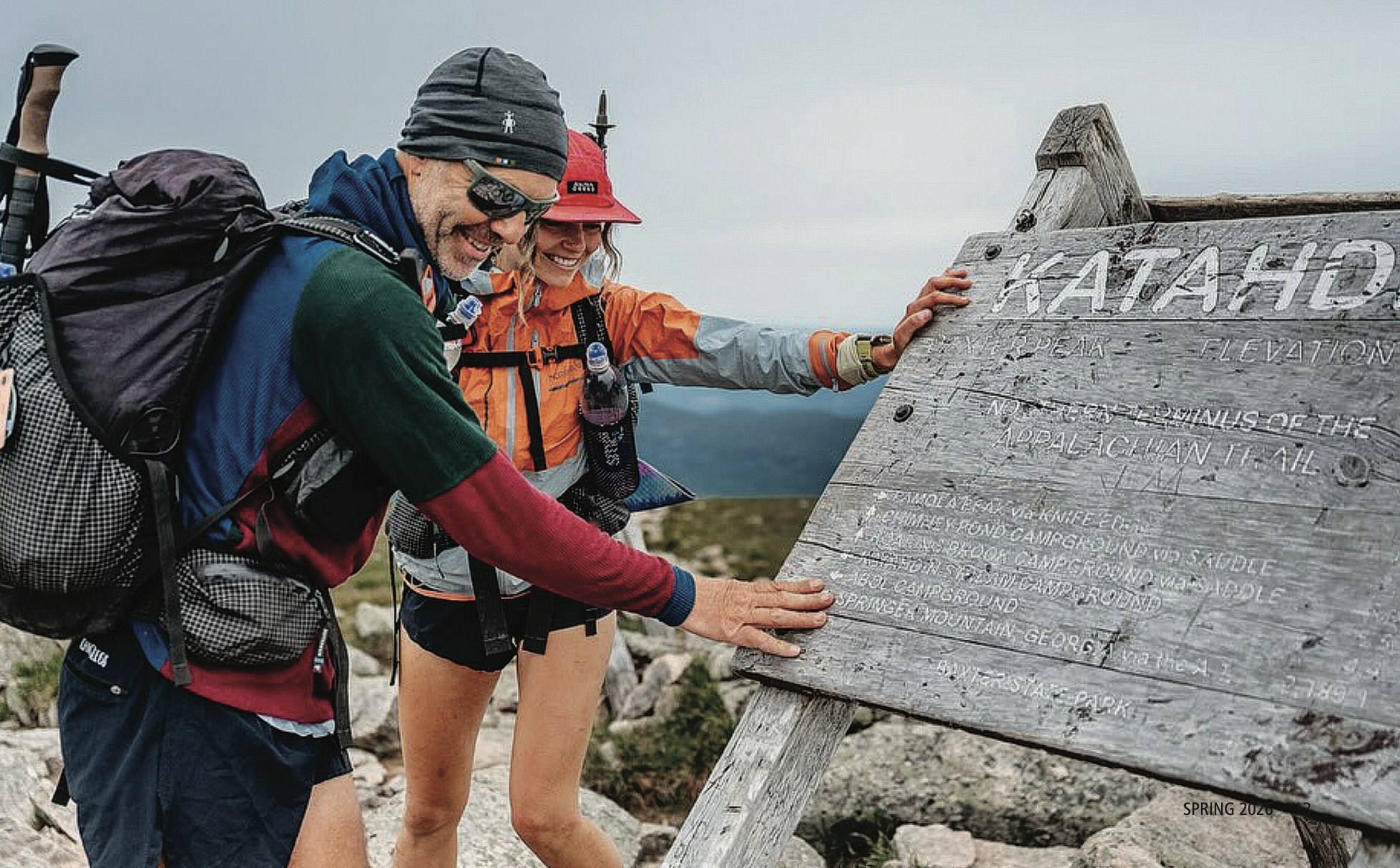
Joined by a small group of family and friends, the father-daughter team finished the AT atop Katahdin, Maine’s tallest mountain, on June 26. It took them 119 days — or about four months.
“It was just one of the most special moments of my life,” Natalie Nicols said. “We started and finished together, side by side. I wouldn’t have been able to do that alone, and I’m OK with admitting it. I wouldn’t want to. I just always felt safe with my dad there.”
The AT taught them to cherish the small things in life — things like shelter, good food, and the company of family and friends. And while the journey was certainly a physical challenge, it was their grit and optimism that carried them to the end.
“I’d say it’s 80 percent mental,” Nicols said. “We really did have positive vibes, and we were so motivated to get it done, to walk home.”